Complete Guide to Professional Pool Inspection in Victoria
Owning a swimming pool in Victoria comes with clear legal obligations. Under current pool safety regulations in Victoria, pool and spa barriers must meet prescribed standards and be certified every four years.
A licensed swimming pool inspector ensures your barrier complies with Victorian legislation and that a valid Certificate of Compliance (Form 23) is issued when requirements are met. The article below explains the inspection process, compliance requirements, and how the service operates.
What Are the Pool Safety Requirements in Victoria?
Here are the pool safety requirements: all pools and spas capable of holding water deeper than 30cm must:
- Be registered with the local council
- Have a compliant safety barrier
- Obtain a Certificate of Compliance (Form 23) every four years
Failure to comply with swimming pool regulations may result in infringement notices, building orders or complications during property settlement.
Newly constructed pools or newly constructed pool barriers do not fall within this certification service category.
What Does the Pool Inspector Check During Inspection?
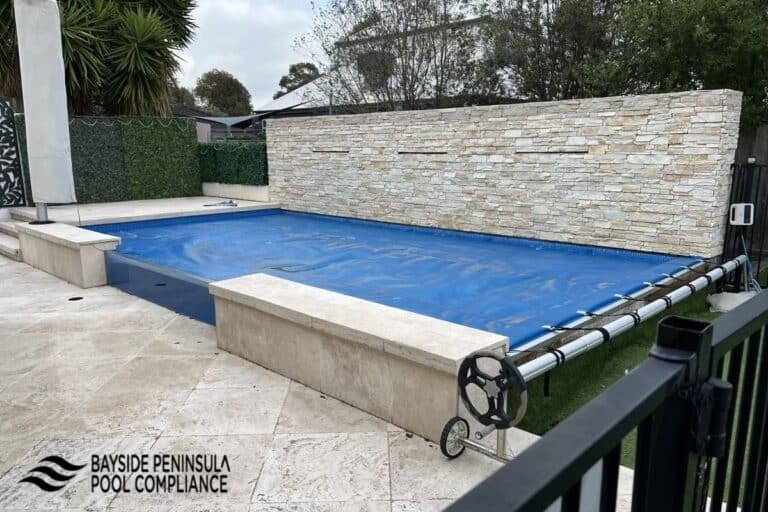
The inspection focuses strictly on the pool or spa barrier system.
Barrier Components
The barrier may include:
- Fences
- Posts
- Panels
- Walls
- Gates
- Doors
- Windows
- Boundary fences forming part of the barrier
- Other fittings restricting access to the pool or spa area
Barrier Height and Gaps
- Minimum barrier height: 1200mm
- Height and width of gaps assessed for compliance
Non-Climbable Zone (NCZ)
- 900mm clearance on the outside
- 300mm clearance on the inside
The non-climbable zone is the designated space intended to restrict young children from climbing and accessing the pool area.
Where relevant, neighbouring property conditions may also be considered to ensure compliance with NCZ requirements.
Gates and Fittings
- Must be self-closing
- Must be self-latching
- Must operate correctly without manual assistance
Windows and Doors (If Forming Part of the Barrier)
- Maximum window opening of 100mm
- Fasteners must require a tool for removal
- Sliding panels must not be removable
- Bolts must limit window opening
- Minimum window height from ground assessed
Structural and Material Assessment
- Impact load and load rating
- Construction material and barrier type
- Structures contained within the barrier
What Happens If Minor Issues Are Found?
Where minor adjustments can be made on the day, they may be addressed immediately. Examples include:
- Moving furniture or pot plants out of the non-climbable zone
- Minor barrier adjustments
This may allow compliance to be achieved during the same visit.
What Happens If the Barrier Is Non-Compliant?
If the barrier does not meet legislative requirements:
- A report of non-compliance is issued
- Required rectifications are clearly outlined
- Owners must complete the works within 7 days
What Is Included in a Re-Inspection?
Re-inspections are included at no additional cost.
The re-inspection process includes:
- Review of original inspection documentation
- Re-assessment of identified non-compliance
- Determination of compliance status
Possible outcomes:
- Barrier is compliant → Certificate of Compliance issued.
- Progress has been made → Further period (up to 7 days) may be provided.
- No progress → Certificate of Barrier Non-Compliance issued.
All inspections are digitally documented through checklists, photos and records, which are retained for up to 10 years.
What Is Not Covered During Inspection?
The service does not include:
- Certification of newly constructed pool barriers
- Chemical balance or storage matters
- Mechanical components such as pumps, filters or jets
- Structures not forming part of the barrier
- Non-compliance unrelated to the swimming pool or spa barrier
- Slip, trip or fire-related matters
The inspection is strictly limited to legislative compliance of the barrier system.
Who Provides This Service?
Bayside Peninsula Pool Compliance is a licensed and certified pool inspection service based in Dingley Village, servicing Melbourne, Bayside and the Mornington Peninsula. Our inspector Leigh is authorised to conduct pool barrier inspections and issue the official Form 23 Certificate of Compliance under Victorian legislation.
The pool inspection service is a structured assessment of the swimming pool or spa barrier only. What is included in a professional pool inspection:
- Flat rate pricing with no hidden costs
- No additional charge for re-inspections
- Full digital inspection report provided
- Certificate of Compliance issued within 24 hours once compliant
- The inspection typically takes 30–45 minutes, depending on the configuration of the barrier.
Industry pricing generally ranges between $200–$500. This service is positioned within that professional range with transparent fixed pricing.
Flexible scheduling options are available across metropolitan Melbourne, Bayside, Mornington Peninsula and surrounding suburbs.
Conclusion
Victorian pool laws require barrier compliance to be renewed every four years, and keeping your certification current helps avoid last-minute stress, especially when selling a property. Booking an inspection before your certificate expires ensures everything is properly documented and aligned with current pool safety regulations in Victoria, giving you confidence that your barrier meets statutory requirements.
If your certificate is due or you would like clarity on your pool barrier requirements or pool safety in Victoria, contact Bayside Peninsula Pool Compliance today to arrange your professional pool inspection with our swimming pool inspector.